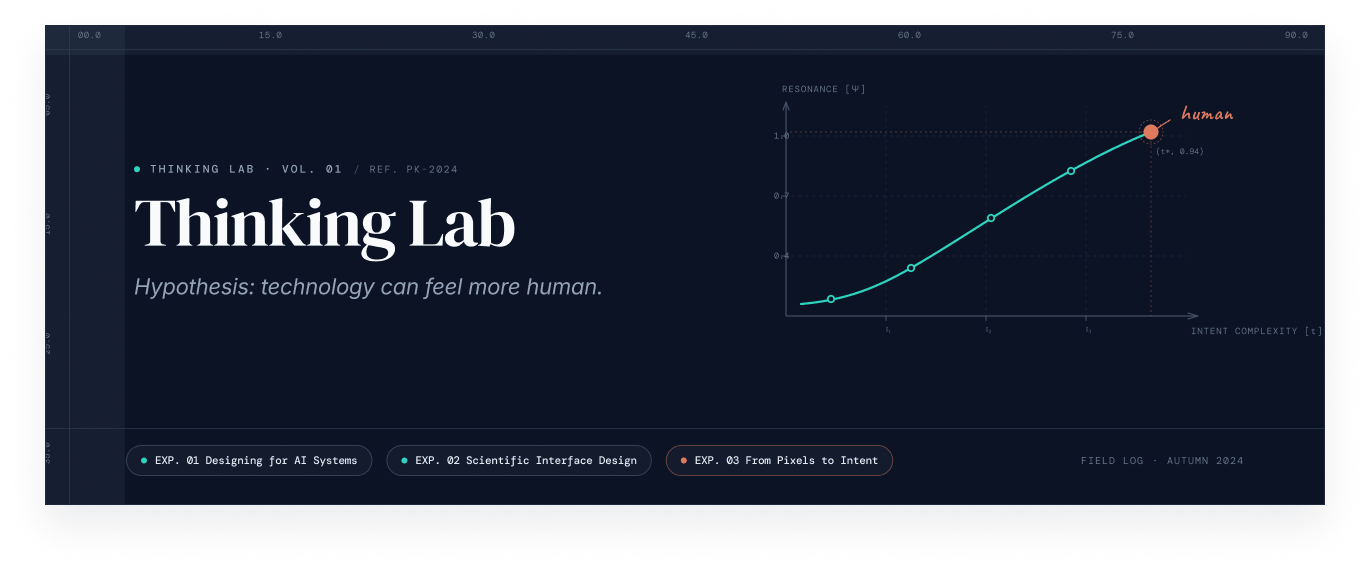
For twenty years, designers have shaped screens.
The next decade is about shaping behavior, meaning what a product does, decides, and remembers when no one is looking at it.
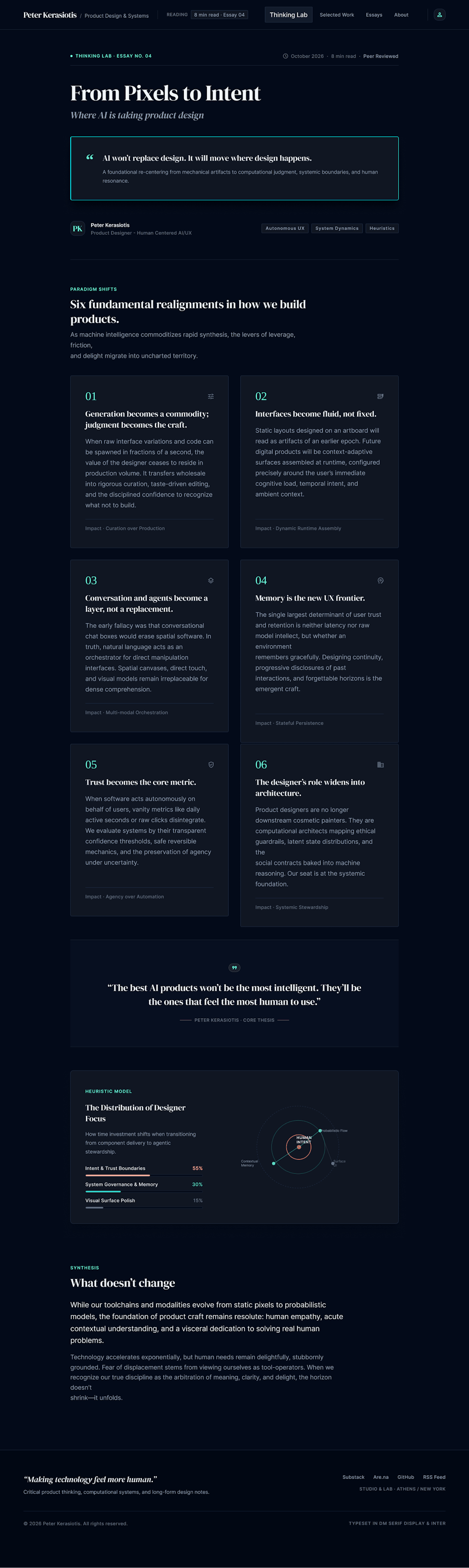
1. Generation becomes a commodity; judgment becomes the craft
Tools like Stitch, Galileo, and Figma’s AI can already produce a plausible screen in seconds. That makes making the interface the cheapest part of the job. What stays scarce is knowing which of fifty options is right, why, and for whom. Designers move from producers to editors and directors, and taste, critique, and rationale become the differentiators.
2. Interfaces stop being fixed and start being fluid
Today we design one layout and ship it to everyone.
Increasingly, the interface assembles itself around the person and the moment: different density, different flow, different level of guidance.
The deliverable shifts from a set of screens to a system of rules, components, and constraints that can flex without breaking.
Design systems stop being documentation and become the product’s grammar.
3. Conversation and agents become a layer, not a replacement
Chat is not the end of UI.
It’s a new input that sits beside it.
The hard design problems are in the seams: when should the product ask, when should it just act, and how does it show what it did?
Agents introduce new states we’ve barely designed for: thinking, uncertainty, waiting for approval, acted on your behalf, wrong.
4. Memory is the new UX frontier
A product that remembers is a product with a relationship.
That raises design questions that never existed before: what does it remember, can I see and edit that, how does it forget, and when does remembering feel helpful versus invasive?
Designing memory means designing consent, transparency, and tone over time.
5. Trust becomes the core metric
As products act more autonomously, usability is no longer enough; users need legibility.
Clear confidence signals, visible reasoning, easy undo, and graceful failure become baseline UX.
This is where “responsible design” stops being a niche and becomes the standard:
nudges that serve the user rather than the funnel, and defaults that protect rather than exploit.
6. The designer’s role widens
Designers will increasingly work upstream and downstream of the screen: defining the AI’s behavior and boundaries, writing the principles it follows, prototyping with real models instead of static mocks, and evaluating outputs the way we once evaluated layouts.
The hybrid designer who can think in systems, prompts, and prototypes will have the edge.
What doesn’t change
Empathy, context, and an understanding of human messiness can’t be generated.
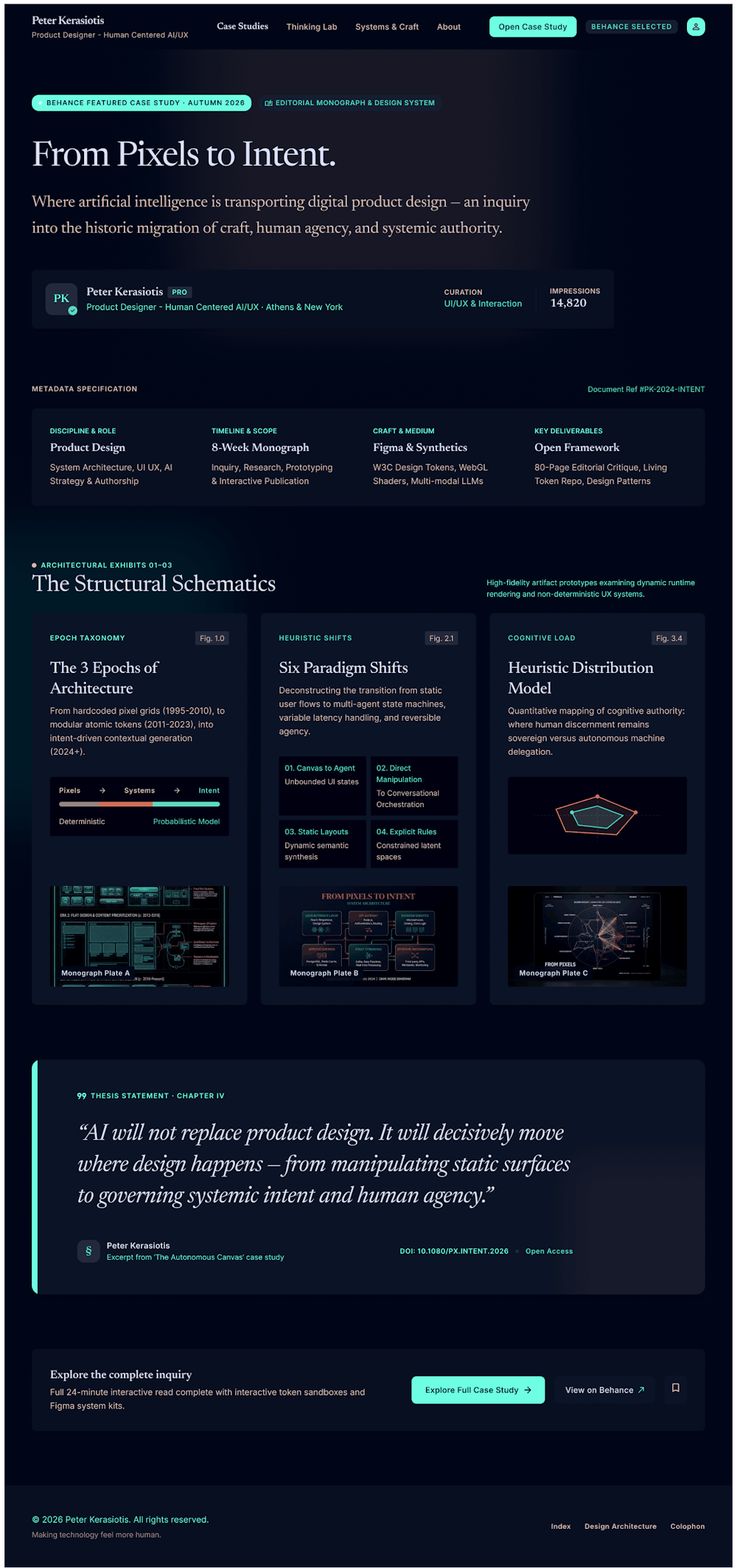
AI can propose, but someone has to care whether the result feels right. The best AI products won’t be the most intelligent; they’ll be the ones that feel the most human to use.
My position: The goal isn’t to design with AI or for AI, but to use it to make technology feel more human.
Designing an AI product means designing something that behaves, not just something that looks a certain way. The screen is the smaller part of the problem. The bigger part is deciding how the system speaks, when it asks versus acts, how sure it should sound, and what happens when it’s wrong. These behaviors become the product’s personality, and users form a relationship with that personality long before they notice the layout.
The craft changes accordingly. The new design materials are states and boundaries: what the system is doing right now, what it’s unsure about, what it remembers, and where a human must step in.
A good AI interface makes all of this legible, with visible reasoning, clear confidence signals, easy correction, and a graceful path when the model fails.
The goal isn’t to hide the intelligence but to make it understandable.
Evaluation changes too. We can’t just test whether someone completes a task; we have to test whether they trust the system appropriately, neither blindly nor not at all.
Designing for AI means shaping that trust on purpose, because it’s the thing every other metric depends on.
What got me thinking about how to design for AI systems is a proposal I did for Epignosis, a SaaS software company specializing in eLearning and HR technology, offering cloud-based LMS platforms.
This proposal for Epignosis, a SaaS software company specializing in eLearning and HR technology, offering cloud-based LMS platforms, is specifically for their flagship product, TalentLMS -the LMS platform they built and sell.
I did a deep dive into the product and into the entire LMS space, comparing the various competitors, their pain points, advantages/disadvantages and how they were implementing AI to improve their product and customer satisfaction/retention.
In the case of Epignosis, which was my focus, TalentLMS currently sits at 58% course completion, trailing LearnWorlds at 68% and Docebo at 62% — a gap that translates to approximately 80 lost completions per quarter.
My dashboard analysis identified three compounding causes of drop-off:
- Format mismatch, where learners with strong video engagement patterns are being served text-heavy modules, particularly at Module 3 which shows a 52% retention collapse across multiple courses.
- Timing problem, where a significant cohort of morning learners are receiving content outside their peak engagement window.
- Momentum gap, where 12 students who completed a course never progressed to the next one, not because they disengaged, but because no pathway nudge existed.
The proposed AI intelligence layer (3 agents) addresses all three without requiring new content to be created from scratch —
The predictive churn model flags at-risk learners seven days before they drop.
The content adaptation agent uses TalentCraft AI (their existing AI) to reformat existing modules into the learner's preferred format with one instructor approval.
The personalization agent adjusts delivery timing and sequencing automatically.
Modelled conservatively, closing just half the gap with LearnWorlds recovers 40 completions per quarter; the optimistic case, where all three AI interventions are active, projects an additional 120 completions — which, depending on course value, represents a measurable and attributable revenue recovery from content that already exists.
I delivered my findings and proposal with a dashboard and presentation/microsite, I am including below.


Scientific interfaces serve people who can’t afford ambiguity. Researchers and lab teams work with dense, high-stakes data, and a misread value or a hidden assumption can cost weeks of work. Here, clarity isn’t a visual preference; it’s a requirement of the work. The design job is to keep complexity visible and manageable instead of simplifying it away.
That means respecting expert users. They want precision, control, and speed, and they tolerate learning curves that consumer products never could, as long as the payoff is real. Good scientific design shows units, sources, and uncertainty alongside the numbers, preserves a clear trail of how a result was produced, and lets experts move between overview and detail without losing their place.
AI raises the stakes further. When a model suggests an analysis or flags an anomaly, the interface has to show how it got there and how confident it is, so the scientist stays in charge of the conclusion. The best scientific tools don’t replace judgment; they give it better evidence and a clear view of what is known, what isn’t, and why.
Never having thought of scientific interface design before, I got really into it when I pitched a proposal to Deus Ex Machina and in order to do so, I took a deep dive into the field and was surprised by what I found.
Deus Ex Machina is Greece's first AI company, founded in Athens in 2017.
They build artificial intelligence platforms for the life sciences, human health, nutrition, and petcare industries — helping research and development teams at Fortune 100 companies solve a problem that has historically taken years and cost millions: figuring out which ingredients to put in a product, at what dose, in what combination, and whether it is legal, safe, and scientifically defensible in every market they want to sell in.
Their AI reads hundreds of thousands of research papers, patent filings, and regulatory databases simultaneously and surfaces answers in hours that a human team could not reach in months.
In 2024 they received a €2 million EU grant to build an ingredient upcycling platform — converting food industry by-products into validated, commercially viable ingredients using AI.
They operate at the intersection of bioinformatics, machine learning, and regulatory science, and they have no peer in Europe doing what they do at this breadth.
The science works. The product is real. Their possibilities are limitless.
The problem is that everything DEM has built was designed by engineers for engineers — and their users are not only engineers.
A research scientist, a product manager, a regulatory affairs officer, and a Fortune 100 client's chief financial officer all need to interact with the same AI output, and right now the interface does not speak to any of them clearly or specifically.
There is no design system, no visual hierarchy, no narrative layer that translates AI confidence scores into human decisions.
The platform functions. It does not communicate.
And for a company whose entire value proposition is making the impossible legible, that gap is the single most important challenge they have.
In order to better understand the space, I took a look at the product AG1 and how the DEM model could actually help them. I saw AG1 as a potential Fortune 100 client. The case study is a fictional but plausible scenario built to illustrate what DEM's platform could do for exactly that type of client. The science is real, the regulatory problem is real, the ingredient interactions are real — but the engagement between AG1 and DEM is invented. The case study is a speculative case study — fictional client engagement created to demonstrate the platform's capability
This is a speculative design proposal exploring what a purpose-built product design system for DEM could look like — created as part of an ongoing research process into AI-native UX and scientific interface design. The work comprises five interconnected surfaces:
- Decision Cockpit giving scientists an at-a-glance command center for AI-ranked formulation intelligence;
- Formulation Lab where ingredients are dragged onto a canvas and interaction modelling runs live;
- Ingredient Knowledge Graph visualizing the relationships between compounds, health outcomes, mechanisms, and patent risks;
- Pipeline Monitor giving the data team real-time visibility into ingestion, model health, and system status;
- Competitive Landscape providing strategic context on the AI life sciences market.
Together they represent a single coherent product language — one that makes a €2 million AI engine feel as clear and trustworthy as the science behind it.


